

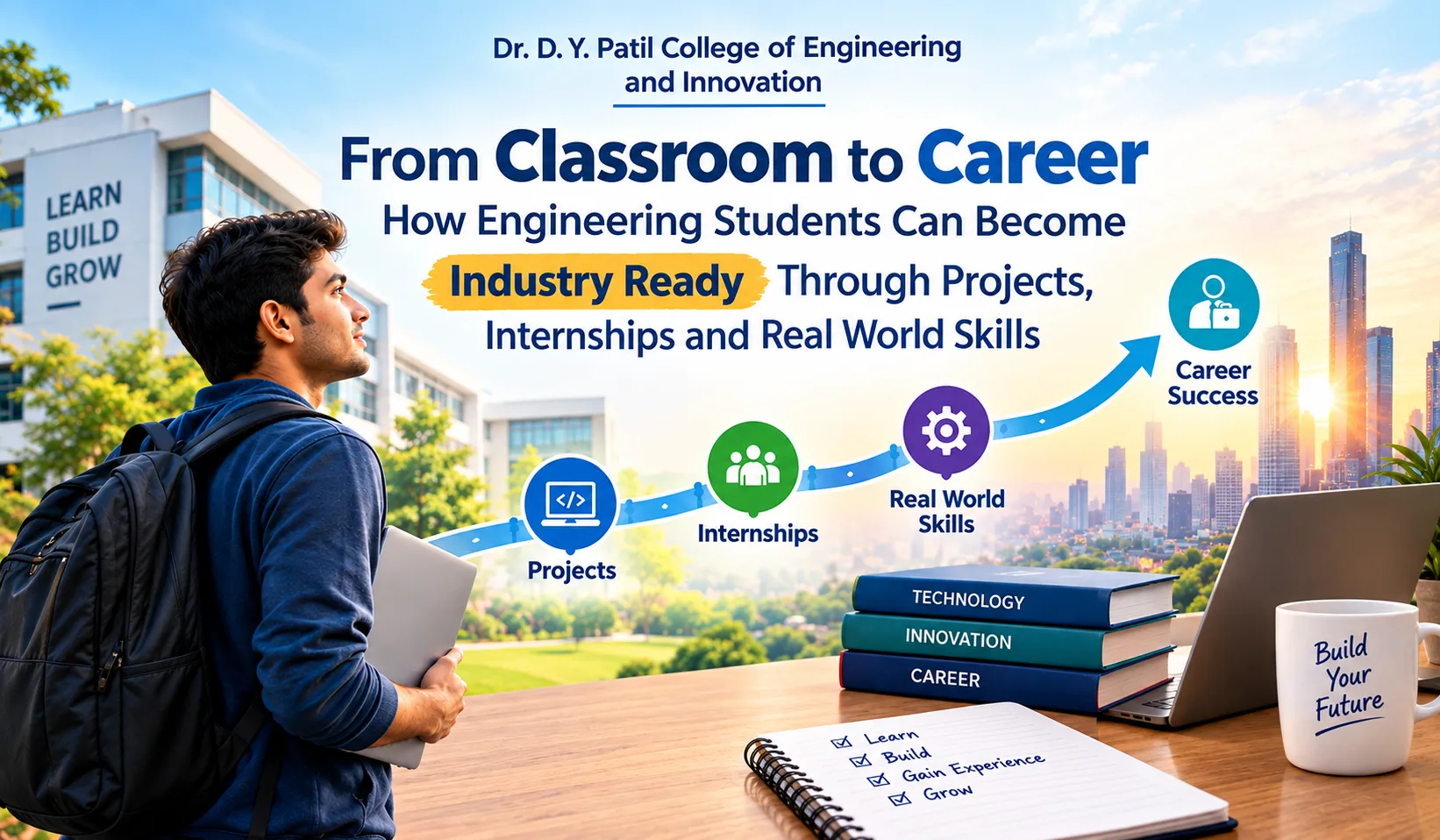
From Classroom to Career: How Engineering Students Can Become Industry-Ready
DYPCOEI Admin2026-09-25T06:24:00+00:00An engineering degree gives students a foundation. What they build on that foundation often determines how smoothly they move from college into a professional career.
For years, engineering education was largely associated with lectures, laboratory work, examinations and academic performance. Those things still matter. Strong fundamentals in mathematics, programming, engineering principles and problem-solving remain essential. But the expectations of employers have expanded.
A graduate entering the workforce today is expected to do more than understand a concept. Employers increasingly want young engineers who can apply that concept, work with others, use modern tools, communicate decisions and solve problems that may not come with a textbook answer.
The shift is already visible in campus recruitment. Deloitte India’s Campus Workforce Trends 2026 describes a campus hiring environment that is becoming increasingly skills-focused. The report also notes stronger internship-to-pre-placement-offer conversion and growing value for AI, data, analytical thinking and problem-solving skills.
For engineering students, the message is straightforward: the journey from classroom to career needs to begin long before the final placement season.
A Degree Opens the Door. Skills Help You Walk Through It.
Academic performance still plays an important role in engineering recruitment. Many companies use percentage, CGPA or branch-specific eligibility criteria while shortlisting candidates. But once students enter an assessment, interview or technical discussion, marks alone rarely carry the conversation.
Recruiters want evidence. Can the candidate write clean code? Can they analyse an unfamiliar problem? Can they explain why they selected one approach instead of another? Have they ever worked in a team where requirements changed halfway through a project? Can they use Git, cloud platforms, data tools, development environments or other technologies commonly used by industry? Most importantly, can they learn something they were not explicitly taught?
These questions explain why engineering employability skills are increasingly built through a combination of academics, practical projects, internships, industry interaction and continuous self-learning.
The World Economic Forum’s Future of Jobs Report 2025 identifies AI and big data, networks and cybersecurity, and technological literacy among the fastest-growing skills towards 2030. Analytical thinking, creative thinking, resilience, flexibility and lifelong learning remain important human capabilities. Technical knowledge and human skills are therefore complementary priorities.
Projects Turn Knowledge into Evidence
One of the most useful questions an engineering student can ask is: “What have I actually built with what I know?” A project transforms theoretical knowledge into visible proof of capability.
A Computer Engineering student who has studied databases can create an application with authentication, APIs and a functioning database rather than merely listing “SQL” on a résumé. An Artificial Intelligence and Data Science student can take a real dataset, clean it, analyse it, train different models, compare their performance and explain why one solution was selected. An AI and Machine Learning student can go beyond running a standard notebook and build a usable application around a model.
The difference may appear small academically, but it is significant professionally. A good project demonstrates several abilities simultaneously: technical understanding, problem-solving, research, experimentation, debugging, documentation and persistence.
Build fewer projects, but build them properly
Students sometimes assume that a portfolio containing 15 or 20 small projects will automatically appear stronger than one containing three serious projects. That is not necessarily the case. A better portfolio might contain:
- One strong individual project.
- One collaborative team project.
- One project based on a real user, organisation or practical problem.
- Clear documentation explaining the problem, approach and outcome.
The project should show more than the final result. Employers are often interested in the decisions behind it. What problem were you trying to solve? What constraints did you face? Which technology stack did you choose? What failed during development? What did you change? What would you improve if you had another month? That discussion reveals much more about engineering maturity than a screenshot of a finished application.
Treat GitHub as a Professional Portfolio, Not Just Code Storage
For students entering software, AI, data science and related careers, GitHub can become part of their professional identity. GitHub Education recommends using school projects to collaborate and develop a portfolio demonstrating real-world experience. Its student ecosystem also provides access to professional development tools and opportunities to work on collaborative projects.
A student repository should be understandable to someone seeing it for the first time. Include a meaningful README. Explain the problem. Describe the tools used. Add installation instructions where relevant. Document the results. Mention limitations rather than pretending the project is perfect. A recruiter should not need fifteen minutes to work out what the project does. Good documentation is itself an employability skill.
Internships Teach What Classrooms Cannot Completely Reproduce
Projects teach students how to build. Internships teach them how work actually happens. During an internship, students encounter deadlines, reporting structures, client expectations, existing codebases, documentation standards, meetings, feedback and dependencies on other people. Even a technically capable student may initially find these situations unfamiliar. That is exactly why internships are valuable.
The AICTE National Internship Portal describes internships as a bridge between classroom knowledge and practical application, providing exposure to professional environments while helping students develop analytical ability, teamwork, communication, work ethics and other professional skills.
Students should avoid viewing internships merely as certificates to add to LinkedIn. Better questions are: What did I contribute? What did I learn that I could not have learned from a course? Which professional tools did I use? What feedback did I receive? What changed in the way I approach a problem? Those answers eventually become useful material for résumés and interviews.
Do Not Wait Until Final Year to Become Employable
One of the most common mistakes engineering students make is treating career preparation as a final-year activity. It should be a four-year process.
First year: build the foundation
The first year should focus on fundamentals, communication, curiosity and disciplined learning. Students do not need to know their entire career path immediately. They do, however, need to develop the habit of exploring technology outside examination requirements. This is also a good time to improve written and spoken communication.
Second year: start building
By second year, students should begin converting concepts into small projects. Explore programming languages, development tools, data analysis, GitHub, open-source resources, coding competitions and technical communities. The objective is not to master everything. It is to discover areas that genuinely hold your interest.
Third year: gain professional exposure
Third year is an ideal time to pursue meaningful internships, participate in hackathons, collaborate on larger projects and start narrowing down a preferred domain. Students interested in software development might explore full-stack development, cloud computing, cybersecurity or DevOps. Students inclined towards AI and data science might deepen their understanding of Python, statistics, machine learning, databases, data visualisation, generative AI or MLOps. By this stage, a student’s résumé should begin to contain evidence rather than only academic information.
Final year: convert preparation into opportunity
The final year should be about refinement. Strengthen the portfolio. Improve the résumé. Practise technical interviews. Revise core concepts. Solve aptitude and coding problems relevant to target companies. Prepare for group discussions and behavioural interviews. Most importantly, learn how to discuss your work clearly. An excellent project that a student cannot explain becomes far less impressive during an interview.
Technical Skills Get Attention. Professional Skills Build Careers.
Engineering students understandably focus heavily on technical expertise. But workplaces run on collaboration. A technically strong engineer who cannot explain an idea, understand another person’s requirements or work constructively with a team will eventually encounter limitations.
Professional readiness includes communication with technical and non-technical audiences; problem-solving that breaks ambiguous challenges into solvable parts; teamwork; adaptability as tools change; time management; and ownership of results. These capabilities improve through repeated practice—projects, internships, presentations, competitions, student clubs, industry interactions and collaborative work.
Learn to Work With AI, Not Just Study AI
Artificial intelligence is no longer relevant only to students pursuing a specialised AI degree. Software developers use AI-assisted development tools. Data professionals use AI to accelerate analysis. Cybersecurity teams use machine learning for threat detection. Product teams use generative AI for research and prototyping. Engineers across disciplines increasingly encounter automation.
The goal should not be simply to become good at prompting an AI system. Students need to understand where AI helps, where it fails and when human judgement is required. Using an AI coding assistant without understanding the generated code is not professional competence. An industry-ready engineer should be able to use modern tools while evaluating output, testing assumptions, identifying errors and taking responsibility for the final solution.
The Role of Industry-Oriented Engineering Education
Students can take significant responsibility for their own career preparation, but institutions also play an important role. Industry interaction, internships, technical activities, placement preparation and practical learning opportunities can help students connect academic concepts with professional expectations.
At Dr. D. Y. Patil College of Engineering & Innovation (DYPCOEI), Pune, current programmes include Computer Engineering, Artificial Intelligence & Data Science, and Artificial Intelligence & Machine Learning. The institution’s pre-placement training covers technical fundamentals, aptitude, soft skills, new technologies, professional certifications and internships, while its Industry-Institute Interaction Cell focuses on industry engagement, projects and technology-oriented programmes.
Such initiatives become most valuable when students actively participate. A workshop becomes useful when a student applies what was learned afterwards. An internship becomes valuable when the student asks questions and takes responsibility. A project becomes valuable when the student pushes beyond the minimum marks required. The opportunity matters. What students do with it matters more.
Build a Career Portfolio, Not Just a Résumé
A résumé is usually one or two pages. A career portfolio is everything behind those pages: GitHub repositories, projects, internships, technical writing, certificates, competition experience, presentations, open-source contributions, achievements and evidence of problems solved. When those assets reinforce one another, the résumé becomes credible.
Instead of writing “Knowledge of Machine Learning”, a student can discuss a machine-learning project, explain the dataset, demonstrate the repository and describe what they learned. Instead of writing “Good communication skills”, they can describe leading a team presentation, documenting a collaborative project or presenting a technical solution to a mentor. Evidence is more persuasive than adjectives.
Industry Readiness Is Built Gradually
There is no single certification, internship or programming language that suddenly makes someone industry-ready. One project teaches you how to debug. Another teaches you teamwork. An internship shows you how companies operate. A failed hackathon teaches you what happens when planning breaks down. A difficult interview reveals gaps in your fundamentals. A presentation improves the way you communicate. Each experience adds another layer.
Students who begin early have more time to experiment, make mistakes, receive feedback and improve before graduation.
Final Thoughts
Engineering education is an opportunity to develop the habits of an engineer. Learn the fundamentals deeply. Build things. Break things. Fix them. Work with people who think differently. Take internships seriously. Document your work. Learn modern tools. Communicate clearly. Stay curious when technology changes.
Companies will continue to change the technologies they use. Job titles will evolve. Some skills that appear essential today will eventually be replaced by others. The ability to learn, build, adapt and solve meaningful problems will remain valuable. The strongest transition from classroom to career happens when students start practising professionalism while they are still students.